















Apollo Lunar Roving Vehicle
NASA Code 3 Collectibles Statues and Busts
Shopping for NASA Statues and Busts?
Take a look at our huge selection of Action Figures, Funko Pop! Vinyl Figures, Model Kits, Statues and Busts, Mini-Figures, and Vehicles: Die-Cast Metal!
-
This item is NOT FOR SALE. We do not expect any further shipments of this item and are keeping it on our website for informational purposes only.
Description
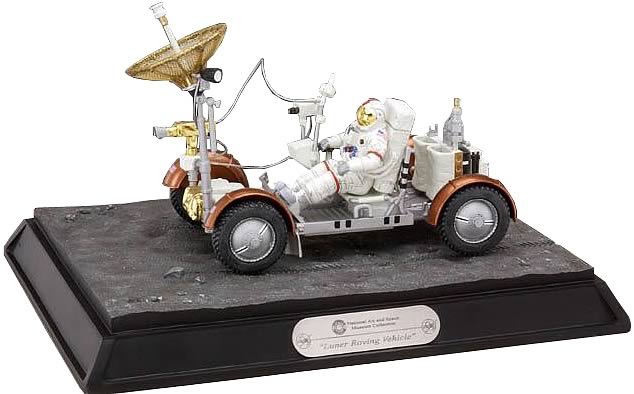
Apollo Lunar Roving Vehicle:This is a hand-casted and hand-painted, exquisitely recreated replica of one of the amazing lunar crafts created in America’s efforts to conquer space. Artists worked to recreate in intricate detail this historic scene. All of the gold accents on the Lunar Roving Vehicle and the Astronauts are real 24K gold-plated. The finished base is adorned with a special silver plaque. The base measures 9 x 11-inches and the Roving Vehicle stands a full 7-inches high, measured from the bottom of the base. Each collectible comes with a numbered certificate of authenticity. Limited Edition of 3,000 pieces worldwide. (Subject to change.)
The missions after Apollo 11, Apollo 12 - 17, conducted increasingly sophisticated studies of the Moon, yielding new scientific insights into the evolution of our celestial neighbor. Beginning with Apollo 15, astronauts conducted their explorations with the aid of a Moon car - a Lunar Roving Vehicle (LRV) - that allowed them to travel and work miles away from their Lunar Module. The LRV carried two astronauts along with their life-support systems, scientific equipment, and lunar samples on the airless, low gravity surface of the Moon. It had a range of about 92 kilometers (57 miles), allowing astronauts to place instruments and collect samples away from the immediate area of the lunar module. The vehicle had power for up to 78 hours of operation. An LRV also was used during Apollo missions 16 and 17. The three LRVs were driven a total of 88.3 kilometers (54.8 miles). The wheels of the lunar roving vehicles were specially designed to provide support and traction in the soft lunar soil. Astronauts operated the LRV using controls at an instrument panel. The foil-covered television camera was operated by Mission Control in Houston. This allowed ground controllers to monitor the activities of the astronauts and photograph the launch of the lunar module ascent stage. Length: 3.1 m (10 ft 2 in) Width: 1.8 m (6 ft) Weight: On the Earth - 210 kg (462 lb) Maximum Speed: 14 km/h (9 mi/h).
Specifications
- Company:Code 3 Collectibles
- Theme:NASA
- Product Type:Statues and Busts
- Weight:9 lb
-