















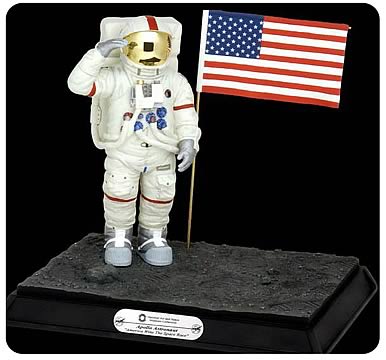
Apollo Astronaut on The Moon Replica
NASA Code 3 Collectibles Statues and Busts
Shopping for NASA Statues and Busts?
Take a look at our huge selection of Action Figures, Funko Pop! Vinyl Figures, Statues and Busts, Model Kits, Mini-Figures, and Key Chains!
-
This item is NOT FOR SALE. We do not expect any further shipments of this item and are keeping it on our website for informational purposes only.
Description
Apollo Astronaut on The Moon Replica:The America on The Moon The Apollo Astronaut is a hand-casted and hand-painted, exquisitely recreated replica of an important moment in America’s efforts to conquer space. Artists worked to replicate in intricate detail this historic scene. The astronaut’s face shield is 24K gold-plated to capture the true reflective surface of the real life shield. The finished base is adorned with a special silver plaque. The base measures 9-inches x 11-inches and the astronaut stands an imposing 11-inches high, measured from the bottom of the base. Each statue comes with a numbered certificate of authenticity. Limited edition of 3,000 pieces worldwide. Part of the Code 3 Collectibles Smithsonian Air & Space line.
“I am extremely pleased with the craftsmanship on the Apollo Astronaut sculpture. The detail is amazing, from the space suit itself to the Commander’s red stripes, 24K gold-plated face shield, Apollo XVII patch and detailed life support system. Does it look like me? It’s as authentic as it gets ….next to the real thing. It brings back many memories.” - Captain Eugene Cernan.
The Space Race grew out of the Cold War between the United States and the Soviet Union, the most powerful nations after World War II. For a half-century, the two superpowers competed for primacy in a global struggle pitting a democratic society against totalitarian communism. Space was a crucial arena for this rivalry. Before a watchful world, each side sought to demonstrate its superiority through impressive feats in rocketry and spaceflight. Early U.S. manned spaceflights were spectacular successes. The one-man Mercury missions developed hardware for safe spaceflight and return to Earth, and began to show how human beings would fare in space. From 1961 through 1963, the United States flew many test flights and six manned Mercury missions. After Mercury, NASA introduced Gemini, an enlarged, redesigned spacecraft for two astronauts. Ten manned Gemini missions were flown from 1964 through 1966 to improve techniques of spacecraft control, rendezvous and docking, and extravehicular activity (space walking). One Gemini mission spent a record-breaking two weeks in space, time enough for a future crew to go to the Moon, explore, and return. When the Space Race began, there was no rocket powerful enough to send a man to the Moon and back. Both the Americans and the Soviets had to develop a super-booster, or Moon rocket. The United States succeeded with the mighty Saturn V. The Soviets' N-1 Moon rocket never made it into space. On July 20, 1969, as millions around the world watched on television, two Americans stepped onto another world for the first time. The United States successfully landed men on the Moon and returned them safely, fulfilling President Kennedy's vision and meeting the goal that inspired manned spaceflight during the 1960s.
Specifications
- Company:Code 3 Collectibles
- Theme:NASA
- Product Type:Statues and Busts
- Weight:9 lb
-